The badge that usually means an Oxford or a Minor underneath · but not always · and there are two real exceptions
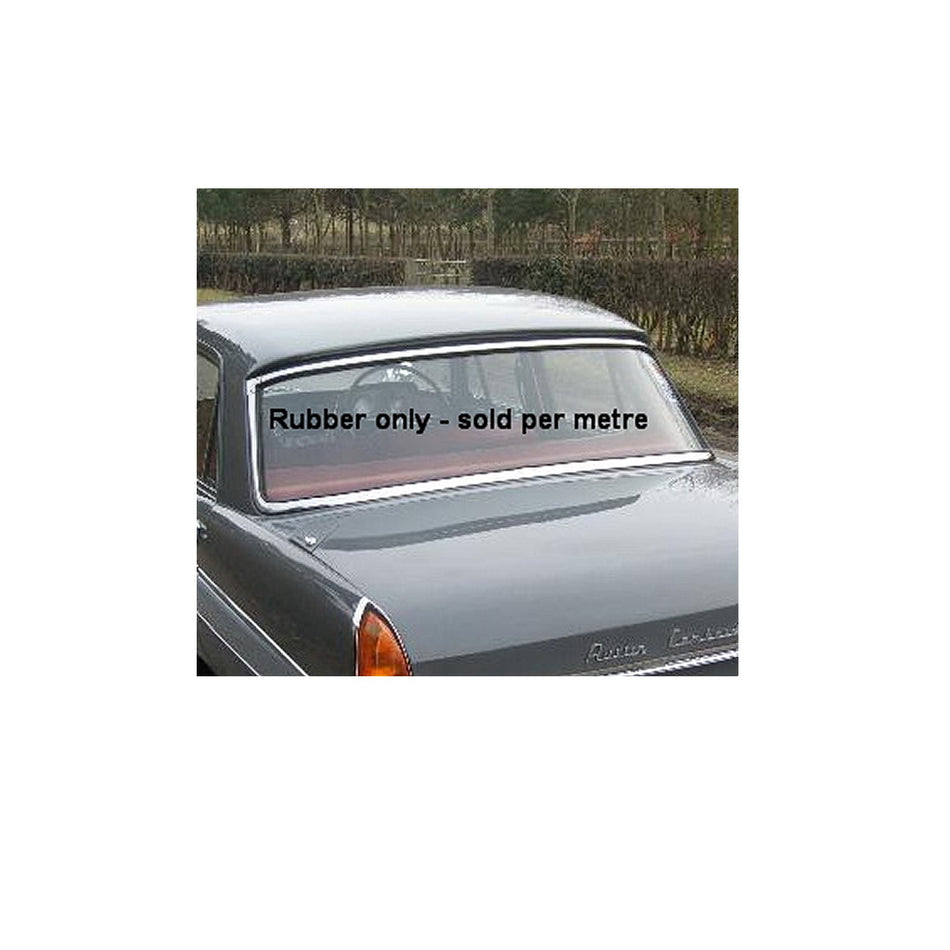
The general rule holds and it is worth stating first. On the badge-engineered BMC cars, grilles, badges, dashboards, seats, instruments and carburettors differ; shells, glass, body rubber, subframes, brakes and suspension are shared. One door aperture seal covers the Austin Cambridge A55 and A60, the Morris Oxford, the MG Magnette, the Riley 4/68 and 4/72 and the Wolseley 15/60 and 16/60. One windscreen seal — ARA1392, ES35 here — covers all six 1100 and 1300 badges. So if the shell is shared, ask us by the donor Morris or Austin model and we will find it.
Exception one: the Wolseley 4/50 is not an Oxford MO with a different grille. This is the single worst badge-engineering assumption in the whole Morris range. The 4/50 (1948–54, 8,925 built) has a 1476cc single-overhead-camshaft engine; the Oxford MO has a 1476cc side-valve. Identical capacity, completely different engine. And the brakes differ too — 9in drums on the Wolseley against 8in on the Morris. The 6/80 (1948–54, 25,281 built) is the Morris Six MS sibling: same 2215cc overhead-cam six, 72bhp against the Morris’s 70, 10in drums, and 7in longer than the 4/50.
Exception two: the Wolseley 18/85 has power steering as standard. On the ADO17 “Landcrab” the Austin and Morris 1800s are described as identical in every respect but the name and the grille — but the Wolseley 18/85 (March 1967) got power steering fitted as standard, which the other two did not. That is a different rack and a pump. It also kept its own rear light clusters at Mk2 where the Austin and Morris went to vertical fin lights. The 18/85S of 1969 is a 96bhp B-series with twin SUs and a three-branch manifold. 35,597 18/85s and 25,214 Wolseley Sixes were built.
The Wolseley 1500 sits on a Morris Minor floorpan — and that is all it takes from one. Shared: the floorpan, the torsion-bar independent front suspension and the rack-and-pinion steering. Not shared: the body (not a Minor panel on it), the engine (1489cc B-series, not the Minor’s A-series), the gearbox (the MG Magnette unit) and the brakes. It was drawn as a replacement for the Minor and pushed upmarket before launch, which is why it sits on Minor underpinnings at all. April 1957 to 1965, 103,394 built, single 1¼in SU, about 50bhp, Lockheed brakes. Series II from May 1960 (hidden boot and bonnet hinges), Series III from October 1961 (revised grille and lighting).
The Farina Wolseleys, and the disc question. 15/60 (Dec 1958–1961, 24,579 built) and 16/60 (Oct 1961–1971, 63,082 built) run Girling hydraulic 9in drums, front and rear, for the whole run — single SU, 52bhp and 61bhp. No four-cylinder Farina ever got discs. The Farinas with discs are the six-cylinder 6/99 (1959–61) and 6/110 (1961–68), the Austin A99 and A110 siblings: Lockheed front discs, anti-roll bars front and rear, cam-and-lever steering, three-speed with overdrive on the 6/99 and four-on-the-floor on the 6/110, optional power steering and 13in wheels at 6/110 Mk2.
And two more you may see. The Wolseley Hornet (Oct 1961–1969, 28,455 built) is a booted Mini — Mk1 848cc, Mk2 998cc with twin-leading-shoe front brakes introduced, Mk3 998cc, rubber cone springs 1961–63 and Hydrolastic from October 1964. It has unique rear windows, pillars, quarterlights, chrome trim and body panels, so Mini body rubber does not all cross. The Wolseley 1100 and 1300 (Sep 1965–1969) is an ADO16 with a strip speedometer in a wood fascia and leather seats — single SU at first, twin later.
In New Zealand, one Wolseley is confirmed as locally assembled. The Wolseley 6/110 Mk II was assembled here in the 1960s. Beyond that, no source we would stand behind establishes local assembly of any other Wolseley — and no source names which plant built the 6/110 either. Logically it would be Dominion Motors, since Wolseley was a Nuffield marque and Austin was handled by a separate organisation at Petone, but that is reasoning, not a source.
Wolseley — specification & changes within the model
- The general rule
-
Differs: grille, badges, dash, instruments, seats, carburettor. Shared: shell, glass, body rubber, subframes, brakes, suspension. Ask us by the donor Morris or Austin model.
- Exception 1 — Wolseley 4/50
-
1476cc single-overhead-camshaft engine, not the Oxford MO’s side-valve. Same capacity, different engine. 9in drums against the Morris’s 8in. 1948–54, 8,925 built. The 6/80 is the Morris Six MS sibling: 2215cc OHC six, 72bhp, 10in drums, 25,281 built.
- Exception 2 — Wolseley 18/85
-
Power steering standard where the Austin and Morris 1800 had none — a different rack and a pump. Kept its own rear light clusters at Mk2. 18/85S (1969): 96bhp, twin SUs, three-branch manifold. 35,597 built; Wolseley Six 25,214.
- Wolseley 1500 — what it takes from a Minor
-
Shared: floorpan, torsion-bar front suspension, rack-and-pinion steering. Not shared: body, engine (1489 B-series), gearbox (MG Magnette), brakes. 1957–1965, 103,394 built, single 1¼in SU, ~50bhp, Lockheed. Series II May 1960, Series III Oct 1961.
- Farina Wolseleys — drums, not discs
-
15/60 (1958–61, 24,579) and 16/60 (1961–71, 63,082): Girling 9in drums front and rear, the whole run. Single SU, 52 and 61bhp. No four-cylinder Farina ever had discs.
- The six-cylinder Farinas — these do have discs
-
6/99 (1959–61) and 6/110 (1961–68): Lockheed front discs, anti-roll bars front and rear, cam-and-lever steering. Three-speed with overdrive on the 6/99, four-on-the-floor on the 6/110. Optional power steering; 13in wheels at 6/110 Mk2.
- Wolseley Hornet
- Oct 1961–1969, 28,455 built. Mk1 848cc, Mk2 998cc introduces twin-leading-shoe front brakes, Mk3 998cc. Rubber cone springs 1961–63, Hydrolastic from Oct 1964. Unique rear windows, pillars, quarterlights, trim and panels — Mini body rubber does not all cross.
- New Zealand
-
The Wolseley 6/110 Mk II was assembled in New Zealand in the 1960s. That is the whole of what a source will carry.
- Not claimed
-
Earth polarity. We will not guess it. No marque club, period road test or factory document we would stand behind states positive or negative earth for this car. Nominal voltage we can give you — and it is worth saying that the Morris Minor was 12 volt from the first car in 1948 to the last in 1971. Check the car before you order anything polarity-sensitive. Which New Zealand plant built the 6/110 Mk II is not stated by any source. Nor is local assembly of the 15/60, 16/60, 1500 or 1100/1300. And note that two Wikipedia articles contradict each other on Wolseley 15/60 power — 52bhp in one, 58bhp in another. We use 52.