- 1939 — the brake line
-
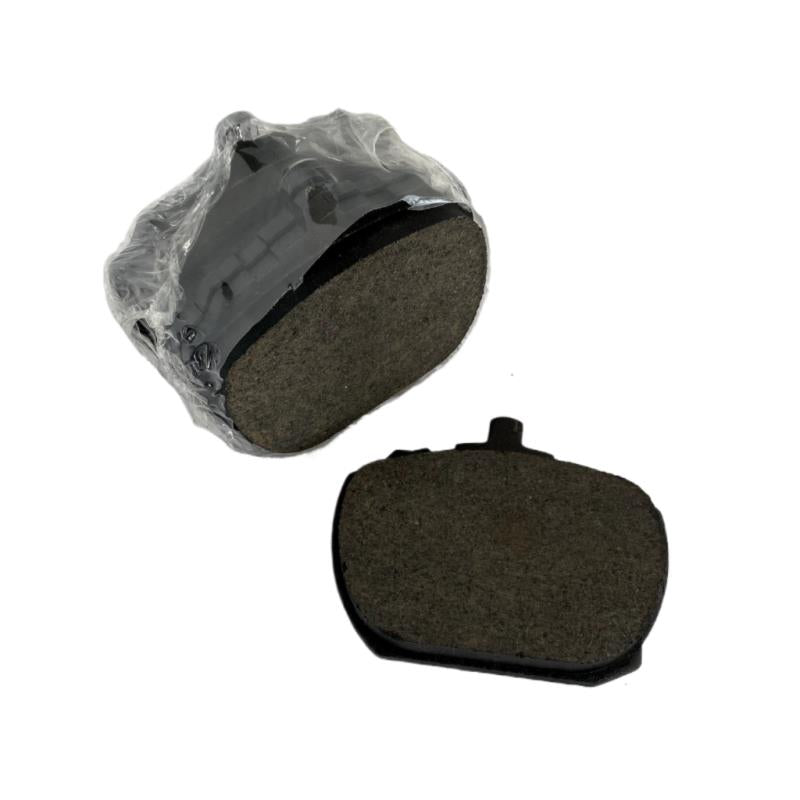
Pre-war W-series Bedfords are rod-braked, with a Dewandre vacuum servo. From the 1939 redesign — K, M, O, OB, and the military OY, OX, MW and QL — they are Lockheed hydraulic with vacuum servo assistance. A W-series lorry and an O-series lorry of the same size share no brake hydraulics at all, because the W has none. This is the first question to ask about a pre-war Bedford.
- Where Vauxhall parts genuinely cross
-
CA — the 1,508cc four of the Vauxhall Wyvern, then the 1,594cc Victor FB unit from 1964. CF — the Slant Four, 1,599 and 1,975 from the Victor FD, then 1,759 and 2,279 from the Victor FE in 1972. HA van — a Viva HA that took HB engines in 1967 and HC engines in 1972. TJ J0 — the 2,651cc Vauxhall Cresta six, the one Vauxhall car engine in a Bedford truck.
- And where it does not
-
Bedford’s truck petrol sixes descend from Chevrolet, not Vauxhall — the 214 and 300 cubic inch units are developments of the Stovebolt, and no Vauxhall car has an equivalent. No Bedford diesel is a Vauxhall engine. Bedford began building its own from 1956; before that a diesel in a Bedford is a Perkins or a Leyland. The CF’s diesels are Perkins and then Opel, and the CF2’s 1,979cc petrol is an Opel CIH, not a Slant Four.
- On a bus chassis the number is the engine
-
5 = Bedford 330 diesel · 8 = Leyland O.350 · 13 = Leyland O.375 · 14 = Leyland O.400 · 70 = Bedford 466. An SB5 and an SB8 are different vehicles under the bonnet. On a Y-series coach it is the middle letter: R = 466, L and M = 500 Red Series, N = 500 turbo Blue Series.
- The 3,519cc six — the wartime engine
- The 214 cubic inch overhead-valve six at 72bhp at 3,000rpm runs through the OY, OX, MW, QL and the OB bus, and the M series. 72,385 OYs, 65,995 MWs, 52,247 QLs, 73,135 RLs.
- An Australian Bedford may not have a Bedford engine
-
Australian TKs could be fitted with Holden 253 or 308 petrol V8s, and GM-H built the CF with Holden 2.85 and 3.3 litre sixes. Worse, from 1972 GM-H badged Isuzu trucks as “Bedford by Isuzu”, dropping the Bedford name by 1979. An Australian “Bedford” of the 1970s may be an Isuzu.
- The Petone trap
-
Petone is General Motors — Chevrolet, Vauxhall, Bedford, later Holden. But Petone is also where Austin was assembled, by Associated Motor Industries for the Austin Distributors Federation, a completely different company on a different site. And Seaview, Lower Hutt is Ford. All three are within a few kilometres of each other and they get confused constantly.
- 1986 did not end the trucks
- Bedford-badged manufacture at Dunstable ended in 1986 and the business went to AWD — which had to use its own name because GM kept “Bedford” for light vans. But the TJ was still being built for export in 1998, and the TK in Turkey by Genoto until 1994.
- Earth polarity
-
We cannot tell you, and we will not guess. The only polarity statement we could find for any Bedford is a single spec database giving the CA as 12 volt positive, and nothing corroborates it. No source gives polarity for the TK, TJ, TL, TM, CF, HA, any bus or any military Bedford, and none gives a date for a changeover. Check the vehicle before you order a coil, a regulator or a radio.