415 Products
Morris Minor
1948–1971 · four dates decide almost every order · and no Minor ever left the factory on discs
Split screen or one-piece? Seven-inch front drum or eight? One lamp hole or two? Answer those and we can quote you with confidence.
Find Morris Minor parts by category
Window SealsWindscreen · Rear screen · Quarterlight
→
Door SealsDoor rubbers · Pinchweld · Bailey channel
→
Boot & BonnetBoot seals · Bonnet rubbers · Buffers
→
Body & TrimPanel rubber · Mouldings · Bumper fittings
→
Clips & FixingsTrim clips · Moulding · Screws · Washers
→
Carpet & InteriorCarpet sets · Underlay · Interior trim
→
Brakes & ClutchCylinders · Kits · Hoses · Pedal pads
→
Suspension & SteeringBushes · Ball joints · King pins · Idlers
→
Engine & GasketsGasket sets · Mounts · Seals · Bearings
→
CoolingHoses · Thermostats · Caps · Senders
→
Ignition & ElectricalPoints · Caps · Rotors · Coils · Leads
→
Fuel & FiltersPumps · Hose · Filters · Exhaust mounts
→
Lighting & MirrorsLamps · Lenses · Bulbs · Mirrors
→
Axle & GearboxSeals · Mounts · Bearings · Universals
→
RelatedMorris Minor TravellerMorris EightMorris MarinaWolseleyRileyMorris
Not listed? Plenty of parts suit several marques and never get the model name in the title — ask us and we will check the books for you.
About the Morris Minor
Four dates do most of the work on this car. October 1956, chassis 448801 — the two flat windscreen panes and the chrome centre pillar become a single curved screen, and the rear window becomes a big wraparound. Nothing crosses that line: not front screen glass, not front screen rubber, not the centre pillar, not rear glass, not rear rubber. September 1962 — front drums grow from 7in to 8in. October 1963 — the rear lamps change from L549 lens units to larger ones with integrated indicators. December 1966 — the front screen rubber changes from a two-piece metal insert to a chrome plastic one. Same glass, different rubber. That last one is the quiet break that catches people, because the car looks identical either side of it.
The three series, and the overlap nobody expects. Series MM, Sep 1948 to Feb 1953, chassis 501–179839, 918cc side-valve. Series II, Aug 1952 to Sep 1956, chassis 160001–448714, 803cc OHV. Minor 1000, 948cc from Oct 1956 (chassis 448801–990289) and 1098cc from Sep 1962 (990290–1294082). Notice that the MM and Series II chassis ranges overlap between 160001 and 179839 — the two cars were built alongside each other for six months, so a number in that band does not tell you which car you have. Go by the engine: side-valve or overhead-valve.
The 1962 car is the trap, and it is the most common mis-order on the model. A car built between September 1962 and October 1963 has the new 1098 engine, the 8in front drums, the ribbed baulk-ring gearbox, the 7.25in clutch and the 4.22 axle — but it still has the old open glove boxes, pull-push switches, banjo steering wheel, “clap hands” wiper sweep and old L549 rear lamps. The widely repeated claim that the 1962 car got a new dash, new seats and new rear lamps is wrong: the rear lamps changed in October 1963 and the dash in October 1964. There is a register — the Dual Personality Minors — that exists purely to document these cars. Order mechanical parts late and body parts early.
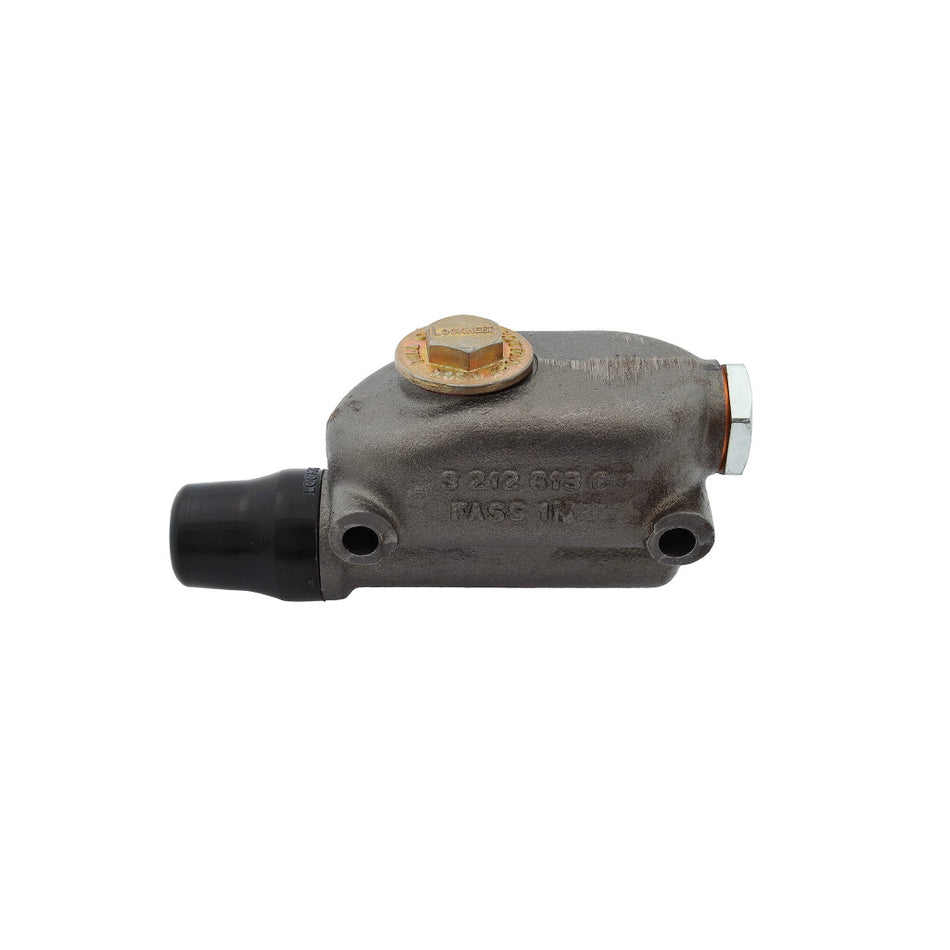
Brakes, plainly. Every Morris Minor left the factory on unassisted hydraulic drums, all four wheels, for 23 years. There is no factory disc-braked Minor. Front drums are 7in to September 1962 and 8in after it; the rear drum stayed 7in from the first car to the last, which is why the trade catalogues one 7in drum as “rear, all models; front, 1953 to 1962”. Note that 1953 date — there is a quieter break there too: front hydraulic fittings change from BSF to UNF thread in 1953, so bleed nipples and banjo bolts split at the same point. The master cylinder lives under the driver’s seat on every car, where it collects road debris, and it is a known corrosion point. Marina and Viva front disc conversions and Lockheed VH44 remote servos are period-plausible and entirely aftermarket.
Engines, and where else they live. The 918cc side-valve (Morris USHM) is shared with the Morris Eight Series E and nothing else — it never went into an Austin. The 803cc is shared with the Austin A30 only. The 948cc is in the A35, the A40 Farina, the Sprite and the Midget — though the Minor used a smaller SU than the A35, so check before selling a carburettor across. The 1098cc is in the Midget, the Sprite, the 1100, the Allegro and more — but see the block warning below, and note the 1098 exists in small-journal and large-journal main-bearing forms.
The Morris Minor was never a 6-volt car. 12 volt from 1948 to 1971 — the 1949 road-test spec says 12 volt, and the Series MM uses the Lucas RF95 control box, which is a 12-volt unit. The 6-volt myth comes from the Morris Eight, which donated the Minor’s 918cc engine and was 6 volt. People carry the voltage across because the engine did. It did not. Charging is a dynamo throughout: Lucas C39 for the side-valve and for 1953–62 cars, Lucas C40 from 1962 with the 1098. No Minor left the factory with an alternator. Two loom dates are worth knowing by heart: the coil moves onto the dynamo in 1955, and the starter goes from pull-cable to key in 1968, at chassis 1192909.
New Zealand cars differ, but only above the floor. A locally assembled Minor has a body-colour grille where the British car has Old English White, body-colour door kick plates where the British car is silver, pale cream wheels unique to New Zealand, black wing piping, locally sourced upholstery and carpets, and optional locally made NATRA heaters. Mechanically they are identical to UK cars. So: sell brakes, engine, gearbox and axle parts to UK specification with confidence, and check trim against the car in front of you.
Morris Minor — specification & changes within the model
- The four dates
- Oct 1956, chassis 448801 — split screen to one-piece. Sep 1962 — front drums 7in to 8in. Oct 1963 — rear lamps to integrated indicators. Dec 1966 — front screen rubber from two-piece metal insert to chrome plastic insert.
- Brakes
- Unassisted hydraulic drums all round, every car, 1948–1971. No factory Minor ever had a disc brake. Front 7in to Sep 1962, 8in after. Rear 7in for the entire 23-year run. Front hydraulic fittings change BSF to UNF in 1953. Master cylinder under the driver’s seat — a known corrosion point. Commercials take different brake pipe sets from cars.
- Chassis ranges — and the overlap
- MM 501–179839 · Series II 160001–448714 · 948 448801–990289 · 1098 990290–1294082. MM and Series II overlap 160001–179839. In that band the number does not identify the car — the engine does.
- Engines
- 918cc side-valve (Morris USHM), 27.5bhp at 4400rpm, Sep 1948–Feb 1953. 803cc 30bhp, Aug 1952–Sep 1956. 948cc 37bhp, Oct 1956–Sep 1962. 1098cc 48bhp, Sep 1962–Apr 1971. Prefixes: APHM · APJM · 9M · 10MA · 10ME · 10AB and 10V (van) · 8AG (GPO van).
- What else changed with the 1098
- Clutch plate 6.25in to 7.25in. Gearbox from cone synchromesh in a smooth case to baulk-ring synchromesh in a ribbed case — first gear is still not synchronised on any Minor. Rear axle 4.55 to 4.22.
- Electrics
- The Morris Minor was never a 6-volt car. 12 volt from 1948 to 1971 — the 1949 road-test spec says 12 volt, and the Series MM uses the Lucas RF95 control box, which is a 12-volt unit. The 6-volt myth comes from the Morris Eight, which donated the Minor’s 918cc engine and was 6 volt. People carry the voltage across because the engine did. It did not. Dynamo throughout — C39 then C40 from 1962. Coil moves onto the dynamo in 1955; starter goes from pull-cable to key in 1968, chassis 1192909.
- Screen parts, by trade code
- Split screen: EXT101 front rubber, EXT102 rear rubber, SV128 chrome centre pillar, GLS101U glass. Oct 56–Dec 66: EXT103 front rubber (two-piece metal insert), EXT104 rear rubber, GLS100 glass. From Dec 66: EXT105 front rubber (chrome plastic insert) — same glass as EXT103 cars.
- New Zealand cars
- Body-colour grille and kick plates, pale cream wheels, black wing piping, local upholstery and carpets, optional NATRA heaters. Mechanically identical to UK cars. Assembled by Dominion Motors at Newmarket; only 385 CKD kits ever came here, all four-door saloons, the last leaving Cowley November 1962.
- Not claimed
- Earth polarity. We will not guess it. No marque club, period road test or factory document we would stand behind states positive or negative earth for this car. Nominal voltage we can give you — and it is worth saying that the Morris Minor was 12 volt from the first car in 1948 to the last in 1971. Check the car before you order anything polarity-sensitive. Also not established: the exact chassis number for the Sep 1962 948→1098 change (the register itself says “approximately 990290” and that the transition was not clean), and the date the 1098 moved from small-journal to large-journal main bearings. Total production is disputed — use over 1.6 million of all types, of which more than 1.3 million were cars, and note sources give 349 or 350 Minor Millions.